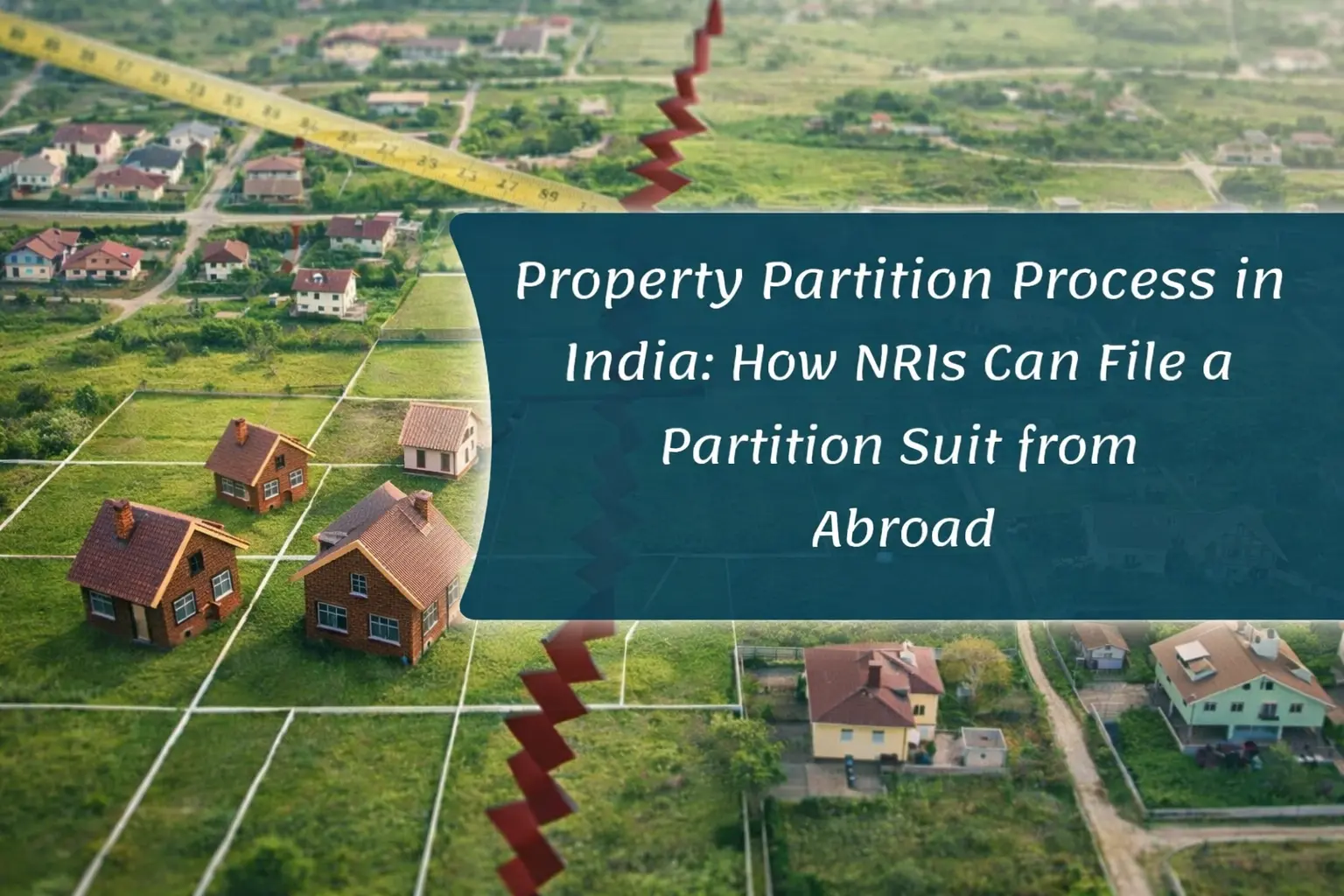
Property Partition Process in India: How NRIs Can File a Partition Suit from Abroad
Family property disputes are very common in India, especially when it comes to jointly owned or ancestral property. Because they are not physically present in India, Non-Resident Indians (NRIs) may find it even more difficult to resolve such disputes. However, by following the correct legal procedures, NRIs can file a partition suit from overseas and claim their rightful share under Indian law.
This article describes how Non-Resident Indians (NRIs) can file a partition suit while residing overseas, as well as the property partition procedure in India.
Understanding Property Partition in India
The legal division of jointly owned property among family members or co-owners so that each receives their fair share is known as property partition. Each co-owner becomes the independent owner of their respective portion of the property after the partition is completed.
Partition typically takes place in the following circumstances:
- Ancestral property
- Joint family property
- Inherited property
- Property jointly purchased by multiple owners
If the co-owners are unable to agree on how to divide the property, any one of them has the legal right to approach the court and file a partition suit.
Once the court issues a decree for partition, each co-owner receives a legally determined share of the property.
Methods for Partitioning Property in India
In India, property can generally be divided through two primary methods.
1. Mutual Partition (Family Settlement)
A mutual agreement between family members is the most straightforward method of dividing property. In such cases, all co-owners agree on how the property should be divided.
A partition deed is prepared and signed by all parties and then registered with the local sub-registrar office. Once registered, the division becomes legally valid.
This method is faster, less expensive, and helps prevent lengthy legal disputes.
2. Partition Through Court (Partition Suit)
If a mutual agreement cannot be reached, the aggrieved co-owner may file a civil suit for partition in the appropriate court where the property is located. The court reviews the legal rights of each party and determines the share that each co-owner is entitled to receive.
If the property cannot be physically divided, the court may order the sale of the property and distribute the proceeds among the co-owners according to their respective shares.
Step-by-Step Property Partition Process in India
Step 1: Sending a Legal Notice
Before filing a partition suit, a lawyer usually sends a legal notice to the other co-owners requesting an amicable division of the property. The notice contains details of the property, ownership claims, and a request for partition. Many disputes are resolved at this stage through negotiation and settlement.
Step 2: Filing the Partition Suit
If the dispute is not resolved, a civil suit for partition is filed in the appropriate court where the property is located. The suit includes ownership documents, information about the parties involved, and the share claimed by the plaintiff.
Step 3: Court Proceedings
Once the case is filed, the court issues notice to all defendants. They are given an opportunity to submit their written statements. The court reviews documents, hears arguments from both sides, and may record witness statements if required.
Step 4: Preliminary Decree
After examining the case, the court passes a preliminary decree that determines the share of each co-owner in the property. At this stage, ownership shares are decided, but the property is not yet physically divided.
Step 5: Final Decree
The final decree is issued after the property is measured and divided. The court may appoint a commissioner to inspect the property and recommend a method of division. Once the final decree is passed, each co-owner becomes the exclusive owner of their respective share.
How NRIs Can File a Partition Suit from Abroad
NRIs often face the challenge of managing property disputes in India while living abroad. However, Indian law allows NRIs to handle such matters through a Power of Attorney (POA).
The first step involves the NRI appointing a trusted person in India who can act on their behalf in legal matters. This person can be a family member, relative, or lawyer.
The second step is executing the Power of Attorney in the country where the NRI resides. The document must be notarized and attested by the Indian Embassy or Consulate.
The third step involves getting the document stamped and adjudicated at the local sub-registrar office in India. After this process, the appointed person can legally act on behalf of the NRI.
Finally, the lawyer can file the partition suit in court through the Power of Attorney. In most cases, the NRI does not need to travel to India for court hearings.
Documents Required for Filing a Partition Suit
- Property ownership documents
- Sale deed or title deed
- Inheritance documents
- Family tree
- Identity proof
- Address proof
- Power of Attorney in the case of NRIs
Time Required for Property Partition Cases
The time required to resolve a partition case in Indian courts can extend over several years depending on the complexity of the dispute, the number of parties involved, and the court's workload. However, in many situations, disputes are resolved earlier through mediation or out-of-court settlements.
Importance of Hiring an Experienced Property Lawyer
Property disputes often involve complicated legal issues such as multiple legal heirs, disputes over ownership documents, illegal possession, and fraudulent transfers. Therefore, it is important for NRIs to hire experienced property lawyers in India who can properly represent their interests.
With the assistance of skilled and experienced legal professionals, NRIs can protect their legal rights, resolve disputes efficiently, and secure their rightful share in family property even while living abroad.